STRANGER Robot alu metallic



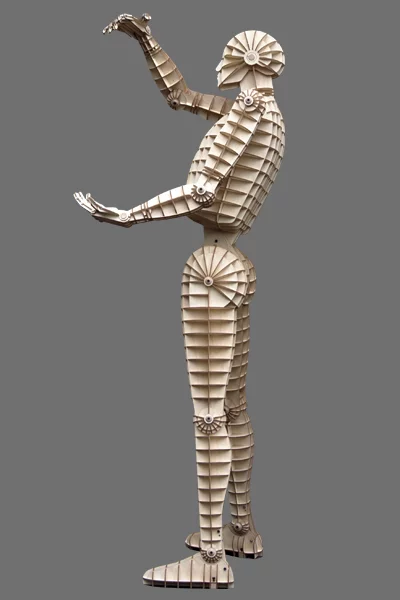
Ergonomics and Range of Motion
Design Options
Passive Joints & Artificial Muscles
Bionic Robot with passive
joints
The licensee integrates its proprietary
artificial muscle technology and adapts the STRANGER robot
chassis design accordingly.
-
Design Option
Bionic Robot with full-body Elasticity
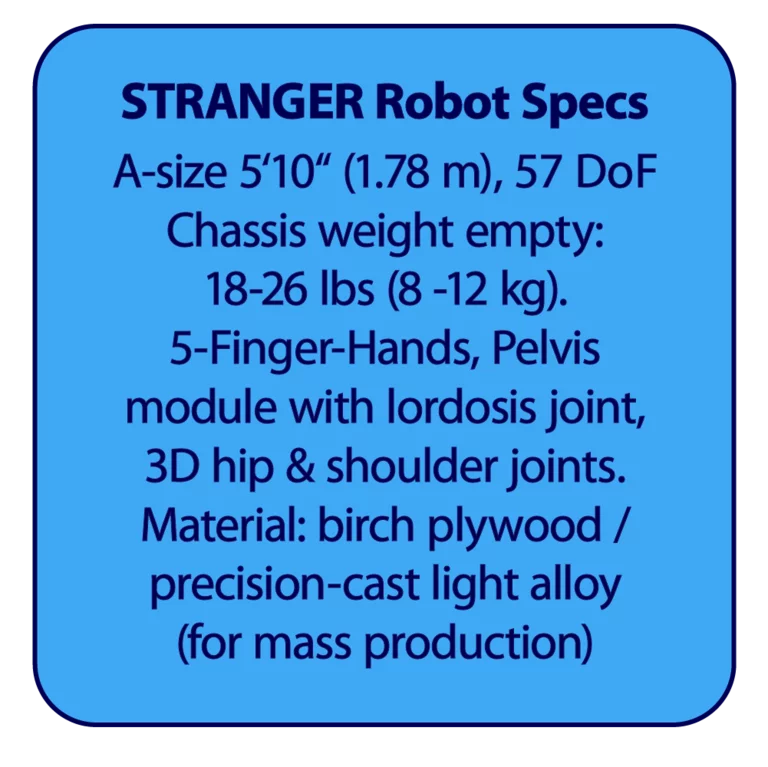
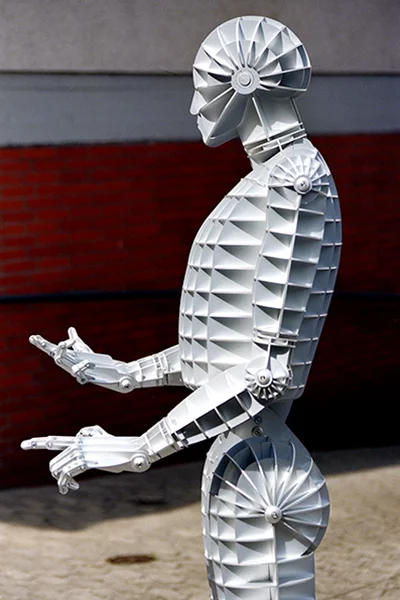
Chassis A-Size 5'10" / 1.78 m with 57 DoF
Chassis weight empty 18-26 lbs / 8-12 kg
Total robot weight: 130 lbs / 60 kg (target)
Equipment weight: 106 lbs/ 48 kg (target)
Passive joints, rubber muscles with tendons, e-motors, servos, sensors, wires, screws, Jetson module, vision system, battery, etc.
-
Physical
Principle
Pulsed passive walker
-
Proposal Muscle
Design
Natural rubber (NR) with high energy storage density. Tensile strength 0.5–1.2 N/mm²–comparable to that of human muscles. Natural rubber is inexpensive, lightweight, durable, and biodegradable.
-
Muscles made of natural
rubber (NR) can withstand 100 to 200 million load
cycles
- Rubber muscles can be designed in various ways: with directly tensioned muscle fibers, or with twisted rubber strings. The second option is particularly suitable when one wants to achieve isometric muscle work, i.e., when one wants to regulate the tensile stress—and thus the force—while keeping the length constant.
-
Muscle Tension
Regulation
active (electromotors) & passive (gravity)
-
Implanted Automatic
Force Sensitivity
Tensioned rubber cords are excellent reversible energy storage devices. They function not only as spring and damping elements, but also as force sensors. Any change in the applied forces, whether internal or external, is sensed by the material and triggers reflexive responses. This essentially eliminates the need for expensive force sensors. The stretch of the rubber cord, which corresponds to a specific force, could then be measured using low-cost sensors. The entire robot body essentially functions like a multi-channel force sensor—even without any electronics.
-
Energy
Consumption
Walking mode approx. 240 W (target):
1/3 = 80 W actively supplied by e-motors
2/3 = 160 W passively supplied by potential energy (gravity, muscle pre-tension)
-
Chassis
Material
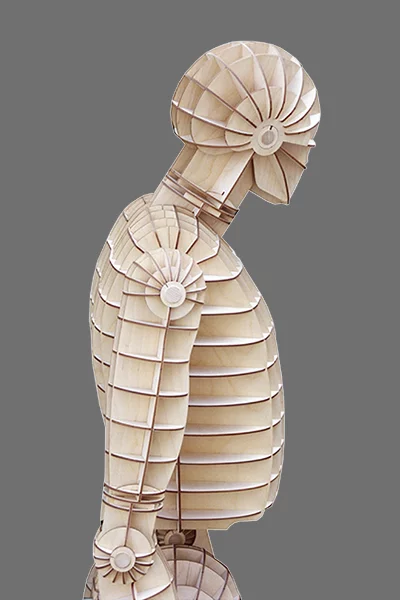
Birch plywood natural, lightweight, strong, high modulus of elasticity, antistatic, and biodegradable
-
Fast, Cost-Effective
Manufacturing
Rapid laser manufacturing of the robot's chassis parts in just 4–6 hours. That's 100 times faster & cheaper than 3D printing
-
Design
Options
Color or metallic finish, protection clothes, waterproof plywood, light alloy casting for mass production, body cover parts
Active Joints vs Passive Joints
Robot with active
joints:
The licensee integrates its proprietary
actuator technology and adapts the STRANGER robot chassis
design accordingly. This design strategy is particularly
well-suited for lightweight, “athletic” robots equipped with
direct-drive torque motors at the shoulder, hip and knee
joints, and would be a great fit for the STRANGER lightweight
chassis.
Pros & Cons Active
Joints
- Advantages: Active (motor-driven) joints are now technically mature and applicable. As developments since 2023 show, motor joints with harmonic drive or planetary gears, rotary and linear actuators, sensors, software and AI are capable of mastering the complex dynamics of a multi-joint kinetic system.
-
Among the most fascinating aspects are the high power-to-weight ratio, the fully integrated modular design, and the ability to incorporate spring-like properties—that is, the elasticity and compliance of the robot joints—into the motor-gear combinations using only software and sensors. In this way, the stiffness of the joints can be continuously adjusted within milliseconds from soft and compliant to hard and rigid.
- Disadvantages: Active motor-driven joints are the main cost factor and worsen the power-to-weight ratio, primarily due to unfavorable lever ratios. They require custom made motors with high torque density, reduction gears with high gear ratios combined with low reflected inertia (a nearly impossible trade-off), zero backlash, and sophisticated torque and position sensor systems. And they force us to develop complex software control systems. The computational demands are enormous—without onboard supercomputers and AI, it would be impossible to control the complex dynamics of a bipedal robot composed of active, motor-driven joints.
Pros & Cons Passive Joints
- Advantages: Biological systems have passive joints that are moved by muscle-tendon actuators. They are not controlled by software, but apparently function according to much simpler principles: an elastically pretensioned skeleton enables passive dynamics and elastic behavior that embodies a morphological intelligence. This results in natural, reflexive behavior coordinated by muscles whose activities are amplified or inhibited by neural networks. The entire system is based solely on forces. Such design principles would largely eliminate the need for expensive force sensors—as well as most of the computational effort required by robots with motor-driven joints.
- Passive joints are simple and non-expensive. They can be combined with muscle-tendon actuators made of rubber cords, whose tension is regulated by standard electric motors. The motors can be positioned at the most optimal locations. If useful, muscle-tendon actuators could also be supplemented by direct-drive torque motors (this design option can be implemented in the pelvic module of the STRANGER robot, which has space for two torque motors).
-
Disadvantages
Real artificial muscles, such as dielectric elastomer actuators (DEAs) are still in the early stages of development. Muscle-tendon systems made of natural rubber or PA-strings (fishing line) are used in some experimental projects and robotic arms, but not yet in fully functional life-size robots, as far as is known.
Furthermore, their elastic behavior is subject to complex nonlinear dynamics that are essentially impossible to simulate and control algorithmically.
Problems: Cost, Durability, Safety
Physical
Limits
Despite all the extraordinary
progress that has been made made in recent years (there are now
at least 50 major companies worldwide that aim to manufacture
humanoid robots), motor joints are not actually the optimal
solution for bipedal robots. So far, this has been the main
approach, though it is sometimes combined with muscle-tendon
actuators, particularly for the hands. However, the design of
motor-driven joint systems is already reaching its physical
limits.
As a result, two main categories have emerged among humanoid
robots: lightweight, fast, and more affordable robots, and
heavier, slower models that, while capable of handling heavier
loads, are physically unable to walk in a natural and graceful
manner due to their sheer strength. The higher gear ratios in
their transmissions make them practically “blind” to reaction
forces below a certain threshold (keyword: reflected inertia),
which is why they are only allowed to take small steps. Even a
pebble could cause them to stumble.
Cost per Motor-Driven
Joint
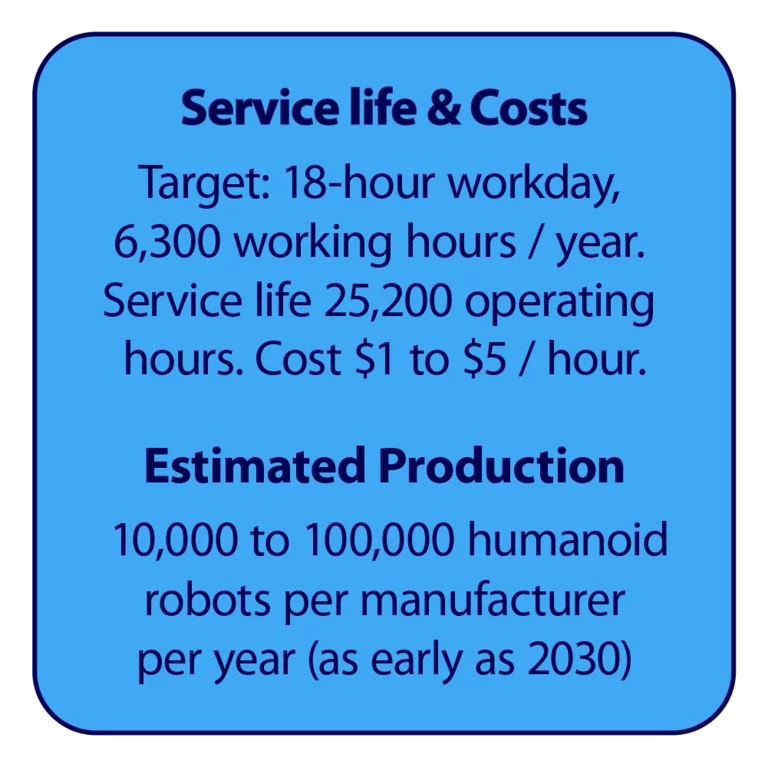
Approx. 1,000–6,000 US-Dollars in mass
production. The massive demand for motor-driven joints and
special linear actuators for robots—of which several million
units are expected to be produced in the coming decade—is
likely to lead to material and supply shortages as well as
rising prices.
Service Life of
Motor-Gear Combinations
Another problem is the durability
and cycle life of the motor-gear combinations. Just imagine the
reaction forces acting on the robot with every step. Depending
on the state of motion, these forces can reach several times
the robot’s body weight. These forces must be able to act
passively and reverse the joint motors; otherwise, they will
immediately destroy the gears. Or the robot loses feedback with
its environment because it doesn’t sense the reaction forces
acting on it at all. This is also a security issue.
Load Cycle
Estimation
A person walking takes about
7,200 steps per hour. That’s 57,600 in 8 hours, 1.728 million
in a month, and around 21 million in a year. For a robot with a
five-year lifespan, that amounts to more than 100 million
impacts and motion cycles that the motor-gear combination would
have to withstand. This is a reasonable estimate for the
required cycle endurance, even if the robot does not walk that
much and performs other movements.
Force Sensitivity: Actio
= Reactio
To walk effectively and perform physical work, a bionic robot
requires morphological intelligence: a body that senses all
forces (acceleration and gravity) and reacts reflexively to
changes in real time. All of this is based on the fundamental
principle of mechanics: Actio = Reactio. This principle can and
must be integrated into the robot’s mechanical structure from
the very beginning—with the highest possible force sensitivity
in both directions, based exclusively on elastic
pretension.
Toward an Optimal
Biomechanical Design
The goal is to understand the holistic nature of such an
elastic biomechanical system and to optimize its physical
behavior through structural measures in such a way that both
energy consumption and control effort are minimized.
Cleverly designed muscle-tendon actuators would be lighter,
more robust (100 to 200 million load cycles), more
energy-efficient, and fully elastic. From a purely physical
standpoint, they would be superior to motor-driven joints and
at least ten times more cost-effective.
However, such physically-elastic
systems are very difficult to train on current AI physics
engines—unless there are attractors, i.e.,
deviation-resistant, self-stabilizing dynamic system states of
the robot that the AI can identify and navigate toward
directly.
To figure this out and make progress with this technology, many
more real-world experiments are needed.
Conclusion
Even though many of the newly
emerging humanoid robot start-ups have high hopes, the
functionality, cost-effectiveness, safety, and autonomy of
humanoid robots have yet to be tested—a process that, as with
the full autonomy of self-driving electric cars, could take 5
to 10 years. So we still have some time; nothing is certain
yet.
We may well find that it is far more cost-effective to pay a
worker—who can easily withstand several billion load cycles
over the course of his working life—60,000 dollars a year than
to employ a robot, which is cumbersome compared to a human,
costs 60,000 dollars or more per year in maintenance and
depreciation, and is capable of doing much less. And who
certainly won’t be buying the products they manufacture. This
is where macroeconomics comes into play. So we still need to
figure out which applications are truly useful and
cost-effective.
With the STRANGER ROBOT project, we are essentially working on
technologies that foreshadow artificial muscles. That is why we
should strive to a better undestand the biomechanics of
elastically pretensioned robots and, above all, to implement
them experimentally, since physical simulations alone are not
sufficient for this purpose–and, due to the nonlinear behavior
of rubber muscles, are also hardly practical.
This includes the effects of muscle loops spanning multiple
joints, the optimal configuration and placement of the
muscle-tendon actuators, and an anatomical or structural design
of the knee and hip joints that ensures the robot consumes
virtually no energy while standing, without losing its passive
responsiveness.
Artificial muscles and applications for humanoid robots are
still in the development stage, in part because, until now,
there has been no cost-effective skeletal structure (i.e.,
standard platform) available for experiments that could be
equipped relatively quickly with artificial muscles and thus
with morphological intelligence–a need that can now be met by
the STRANGER ROBOT R&D CHASSIS.
Coming Next: Proof of Concept
An assessment of wether the
required specifications can be achieved in the most extreme
load case–standing up from a squatting position against the
body weight of STRANGER (assuming 450 N = 45 kg)–using a
rubber-muscle-tendon system driven by ordinary e-motors:
– What pretensions are generated in the rubber cables passively
by lowering into a squat?
– How work the muscle groups in the lower leg and thigh
together with the hip and back muscles?
– What contribution makes the rotation of the pelvis around the
hip joints, caused by activated spline muscles and hip drives,
the torso's inclination, and the position of the arms to
shorten the the load-lever arms?
– How much tension force must be generated in the thigh and
calf muscles, the hip joint drives, and the spline muscles, in
addition to the pre-tension, for a brief moment to initiate the
rise from the squat?
– What is the required torque of the electric motor, and what
is its mass?
– What is the optimal muscle-tendon-motor design
configuration?
In bio-inspired humanoid robot design, there is still plenty to
explore, invent, and improve.
The grace of walking is an expression of the underlying physics
...claims the artist and creator of STRANGER
Seven Reasons to get a STRANGER ROBOT Design License
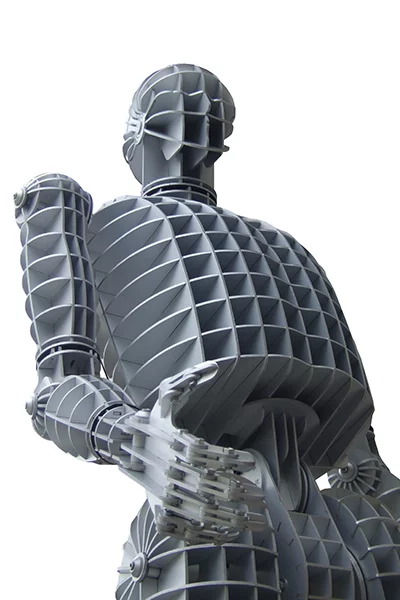
The humanoid robot STRANGER is characterized by a unique plate-skeleton-design with fractal complexity that follows simple geometric rules. This design is particularly well-suited for rapid laser-cutting prototyping during development and testing phases, as well as for manufacturer kits, and perhaps even affordable DIY kits.
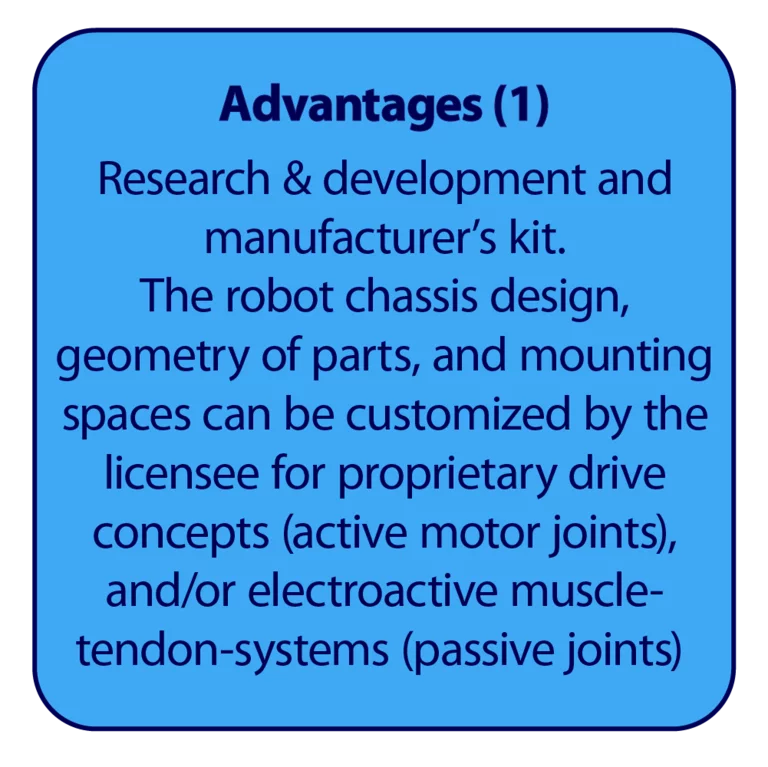
The design strategy is also unique: While the size, ergonomics, kinematics, and range of motion of a humanoid robot are, in principle, invariant design targets (these parameters are ultimately intended to correspond to those of the average adult), the drive and control principles are subject to rapid scientific and technological progress. For this reason, the design strategy was divided into two main components: The chassis, with at least 57 degrees of freedom (DoF), represents the ergonomic and kinematic invariants and serves as a universal biomechanical platform in the R&D and prototyping process. The nature of the drive and control concepts represents the variables that can be integrated according to the state of the art.
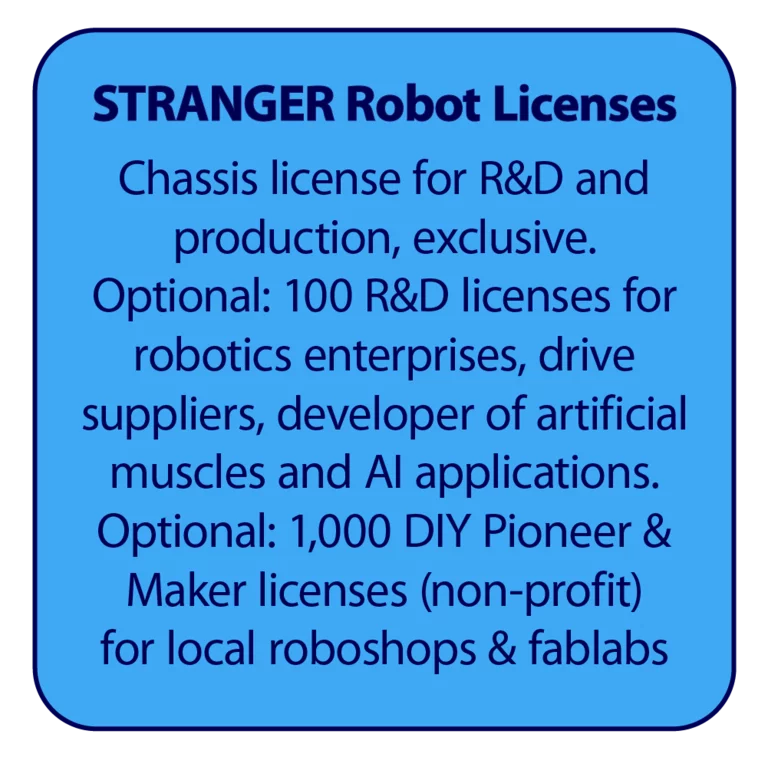
The kinematic chassis with passive joints serves as an R&D design template and, once built as a prototype, as an assembly platform into which a variety of actuators and components can be integrated, particularly artificial muscles. It is also possible to implement active motor joints using proprietary actuator technology and to adapt the chassis design accordingly.
- The STRANGER ROBOT chassis saves time and money in product
development and testing processes. The savings start right from
the 3D CAD model: Designing a feasible, life-size robot chassis
measuring 1.8 meters typically requires several thousand hours
of design work. On top of that, there are the real-world tests
of the prototypes (the STRANGER chassis in its current
form—with a closed chassis—has already been built and sold more
than 100 times). The 3D model of the STRANGER ROBOT chassis,
modeled in Fusion with masses, inertias, and
joints, can be adapted by the licensee to proprietary drive
concepts and internal components and used with physics
engines such as MuJoCo (open source)
or Isaac Sim (NVIDIA, free). The conversion of
XML structures to MuJoCo is done via the URDF format, 99% of
which can be handled by AI. Isaac Sim offers native URDF/USD
support.
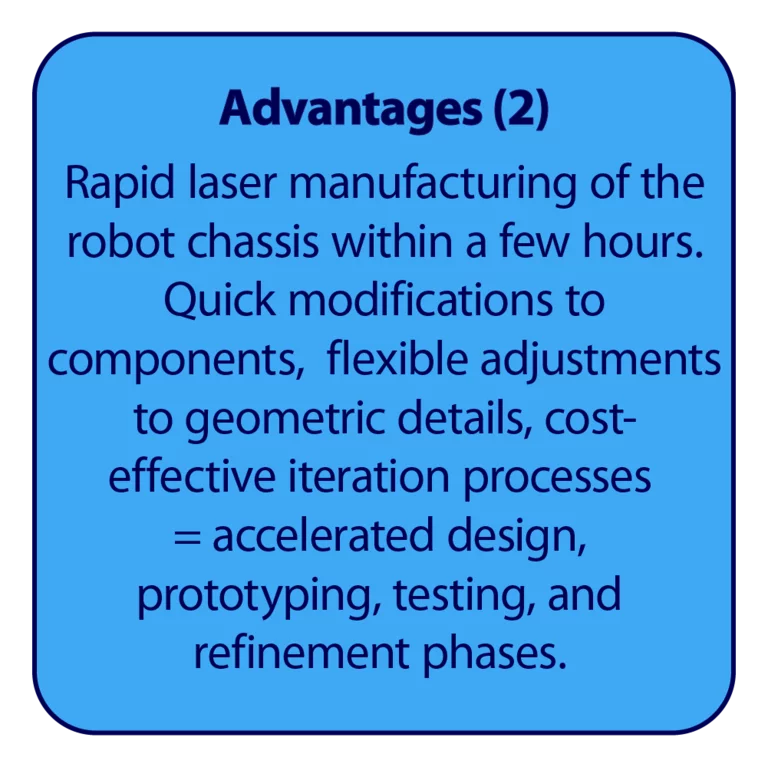
- The STRANGER ROBOT chassis can be manufactured with high
precision on high-speed laser cutting machines in just a few
hours. This avoids costly tooling and prototyping expenses from
the outset and enables rapid modifications. Rapid laser
prototyping is 100 times faster & cheaper than 3D printing.
Birch plywood offers excellent lightweight material properties
and cost-effectiveness. The modulus of elasticity of the 3-ply
birch plywood used is remarkable (10,000 N/mm² along the grain,
aluminum 70,000 N/mm²), while its volume-weight is seven times
lower than that of aluminum (birch plywood 0.38 / alu
2.7).
- The STRANGER ROBOT chassis forms the supporting structure.
The plate-skeleton-design provides ample installation space and
protection for drives and control modules. Frames,
reinforcements, feed-through openings, mounting points, and the
assembly process are customized to the customer’s specific
components, while maintaining the external geometry and
design.
- The STRANGER ROBOT chassis serves as a universal R&D
template and biomechanical standard platform for humanoid
robots, robot arms and 5-finger-hands. Once the custom licensee
design has been tested in the physics engine and all CAD
modifications have been completed, production of the prototype
can begin. Even after the research, development, and
prototyping phases, the plywood chassis can be quickly and
flexibly adapted to various current and future drive systems as
well as to any necessary geometric changes. Once completed and
tested, the STRANGER ROBOT chassis can serve as a
cost-effective manufacturer’s kit, particularly for on-demand
production and small-batch manufacturing.
- The design of the STRANGER ROBOT is timeless, not subject
to fashion trends, and is open—in the truest sense of the
word—to any technology. The type of actuators represents a
variable in this design concept. Possible options include motor
joints and linear roller actuators with elastic properties
(active joints), or muscle-tendon drives designed according to
bionic principles (passive joints), or a combination of both.
The artificial muscles could, for example, consist of
electroactive polymers, or simply of rubber strings tensioned
by electric motors.
- The STRANGER ROBOT chassis can be equipped with clothing
and protective padding. For mass production, the chassis could
be manufactured using light-alloy castings or other suitable
materials and technologies, e.g., laser- or waterjet-cut
aluminum frames, spot-welded. And, of course, the skeleton
design can also be covered with paintable, impact- and
shatter-resistant body parts (e.g., made of PUR-RIM, such as
automotive bumpers)
- The STRANGER ROBOT chassis design can be used both as a
universal humanoid robot template, biomechanical R&D
platform, and as a manufacturer’s kit. This could be of
particular interest to robotics companies and suppliers, as
well as startups—and, with AI support, even to talented makers.
With the STRANGER ROBOT design platform, you can
- accelerate the development and testing of your drive technology in the physics engine
- significantly accelerate the implementation of proprietary joint actuators and/or artificial muscles and control principles
- produce a low-cost DIY robot
- develop affordable personal robots to tap into the consumer market
- develop high-performance sports robots, and much more